History
The emergence of St. Vith
According to one opinion there stood once a Celtic temple on this spot or St. Vith was already in the Roman, respectively Franconian time, inhabited. Other local researchers are of the opinion that the existence of St. Vith began during the Third settlement period (850-1150).
No pre-, respectively, early historic finds had been done in this part of the town, so that the conclusion was that this area in pre-Roman and Roman times no settlement area was, but indeed a transit country.
This conjecture is supported by the fact that old settlements-, respectively, cult spots in the vicinity of St. Vith once existed (Breitfeld, Wiesenbach, Neundorf), which were built in mountain- or valley regions and offered protection against the weather. At the same time the plateau of St. Vith also had advantages at the level of military- or trade strategies as well as in regards to the climate.
The settlement has more than likely developed as a trade- and pilgrims place from 900 AC at the crossing of the in north-south positioned old Roman road from Rheims to Cologne and the local, in west-east positioned connection between the old cities Malmedy and Prüm as in the 12th century charters the Vitus Church as well as the custom points are mentioned. Here St. Vith emerges from the darkness of history for the first time and presents itself as a really important place.
Saint Vitus of Saint Denis
The abbey, founded in 648 by the Aquitanian monk Remaclus on grounds that were donated by the Merovingian King Sigibert III, were governed in the 12th century by abbot Wibald (1098-1158).
Wibald also was abbot in the abbey Corvey on the river Weser.
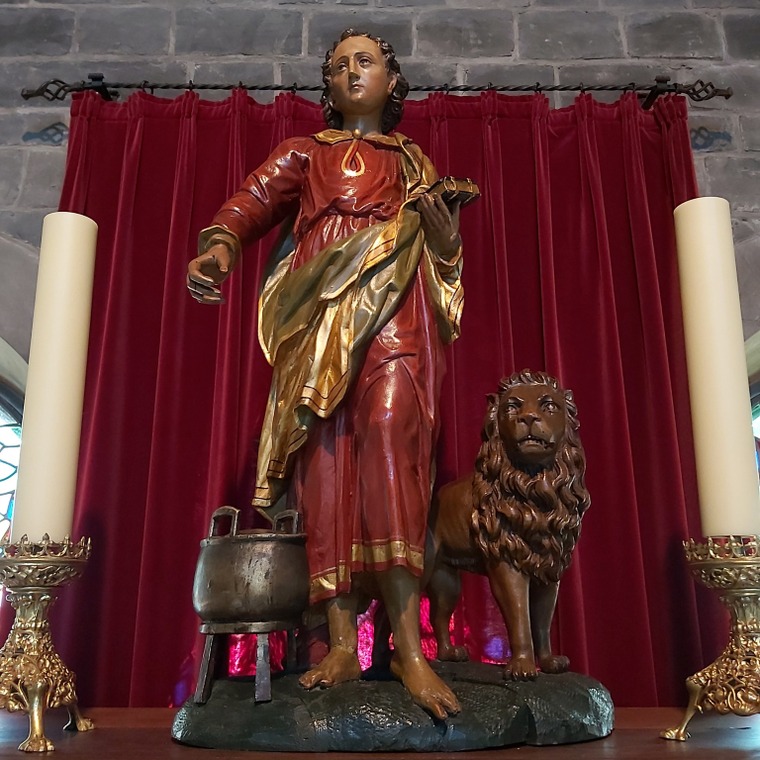
In the year 836, relics of the martyr Vitus of Saint Denis (France) were brought here.
Currently it is more than probable that relics of the holy Vitus who was greatly worshipped in the Middle Ages, were brought here by abbot Wibald via Malmedy to St. Vith and in this way gave the place its name (ad sanctum vitum).
The favourable position at the crossroads of streets quickly led to a growing recognition of the place as from 1151 custom points of the Duke of Limburg were built. By the end of the 12th century the streets, that led from Cologne to the south west, were called ‘via de sancto Vito’.
Duke Walram the Elderly of Limburg remarried in 1214 Ermesinde of Luxembourg. His son from his first marriage, Walram (also called the Younger or the Tall) married in 1225 the daughter of Ermesinde, Elisabeth of Bar. After Ermesinde’s death (1247), Elisabeth’s half-brother Heinrich the Blond, received the hereditary custom rights in St. Vith. The influence of the Luxembourgian in the region around St. Vith grew further as in 1265 Heinrich the Blond obtained shares of the Neundorf Court, which until then, belonged to Knight Kuno of Schönberg.
Development as a trading city
The significance of St. Vith as a trading city grew in the 13th century.
The St. Vitus bushel (Vitus bushel) is mentioned in the deeds of purchase from this period and these bushels were even valid until the French lordship.
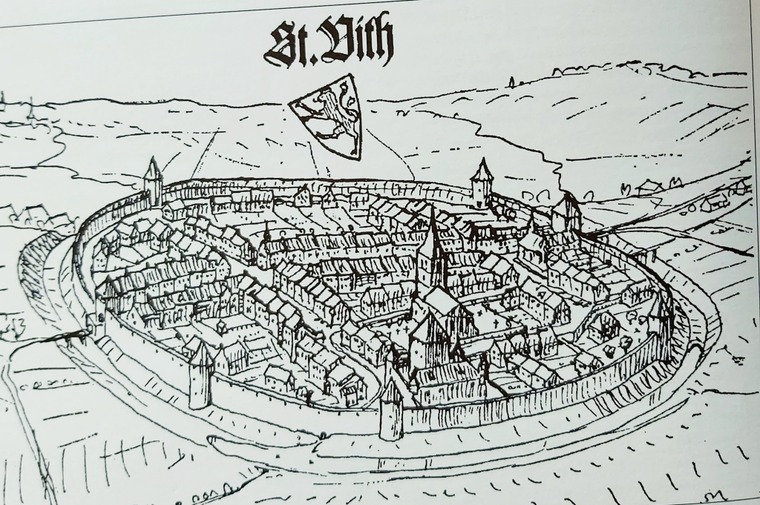
Johan of Valkenburg-Montjoie, a Luxembourgian vassal, made history as Lord of St. Vith; under his lordship the meaning of St. Vith as a trading city was strengthened. As such the building of the castle and the city walls with their fortified towers, took place in 1350.
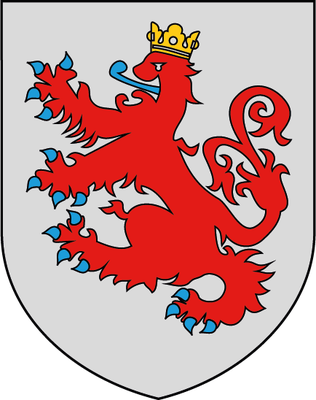
St. Vith was also renamed a city in this period and was allowed since then to carry the weapon (Luxembourgian-Valkenburg lion) that until this day still refers to the first well-known Lord of St. Vith, Johan of Valkenburg. Moreover, the last heir of this house had ordered to mint coins in St. Vith: the ‘moneta Sancti Viti’.
After the death of Johan (1352) the Valkenburg inheritance battle started between his sister and the faithful Valkenburg people. Only in 1380 the Knights Court of the Duchy of Luxembourg, allocated the county of St. Vith to Simon of Sponheim-Vianden and appointed Duke Wenzel of Luxembourg as suzerain of the area.
Simon of Sponheim was married with the daughter of a count, Maria of Vianden. The area around St. Vith expanded now to a unit that belonged to the County of Vianden and existed in this format for 400 years.
After the death of the last heir of Sponheim in the year 1417 the County Vianden, with its lordship of St. Vith, came into the possession of the Count of Nassau (who later was called the Prince of Oranje-Nassau). The Lords of Nassau, and more specifically of Oranje-Nassau, who only lived part-time in the Castle of Vianden, let prefects (for example van Rolshausen, van Münchausen, Kröff, Baring, de la Fontaine, van Dhaeme) rule over the lordship of St. Vith in their name.
The prefects lived in the Castle of St. Vith. Yet as the highest landlords, the counts and later the dukes of Luxembourg were more favourable of our area.
Since St. Vith was connected to Vianden, the meaning of the city under the lordship of the count of Sponheim and the duke of Nassau grew; the city expanded economically (trading city), administrative (the Supreme Court was the seat of the tenants and the prefects) and military (accommodated a garrison) to a centre, as strategically important point at the northern border of het County. The economic rebirth, however, was interrupted in the course of the centuries by wars, fires and epidemics.
Thus, the Black Plague, that raged in the middle of the 14th century through Europe, also killed a large part of the inhabitants of St. Vith. In this period (around 1350) we can probably find the building of the first hospital. City fires destroyed the city several times in the 16th century, which can be seen in the year 1517 and before 1541.
Destruction and annihilation
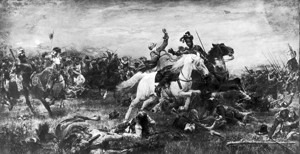
Destructions by fire often were a result of the wars that St. Vith had been plagued with until the most recent past.
Duke Wilhelm of Jülich, an ally of the French King, burned down the city in 1543. The Luxembourgian land, that was part of the Spanish Netherlands, as well as the area around St. Vith, were plagued by fires and murdering gangs in the 16th and 17th century.
The city chronicles of St. Vith mention a raid by Philip of Nassau who, on the night of the 17th of January 1593, tried to enter the city through a gate that was left open, using 1200 horsemen and 500 foot soldiers. Because of the restrained manner of a priest, named Philip Viltz, this attempt was aborted. Nine years later (1602) the Dutch forces under the supervision of Ludwig of Nassau, again appeared in front of the tower of St. Vith and threatened with total destruction of the city when a ransom was not paid. The people of St. Vith paid the ransom and avoided with this act that, after the destruction of the city, it would also be burned to the ground.
In the course of the Three-Year War, St. Vith was attacked and looted in 1632 by Dutch troops. In addition, the Black Plague costed many citizens of St. Vith as well as the surrounding area, their lives.
The peace of Westfalen (1648) that ended the Three-Year War, however, still brought no peace.
The French King, Louis the 14th, invaded the Spanish Netherlands several times. In 1675 St. Vith was looted by French troops, money sums were extorted and wealthy citizens were taken hostage.
In 1684 France managed to establish its rule over the Duchy of Luxembourg, after the surrender of the Luxembourgian settlement to the garrison.
The year 1689 was, like the year 1944, a year of destruction of the city.
In the war against the German Empire and the Netherlands, Louis the 14th ordered to destroy all settlements on the borders of the enemy territories. The settlement of St. Vith thus fell prey to his politics of ‘the scorched earth’ that took place in March.
The complete annihilation continued around the 5th of September when the city was turned to ruins and ashes by ‘French murderous gangs’.
The rebuilding was still on its way or almost finished when a new catastrophe destroyed the city a year later: a ruthless city fire destroyed the newly built houses and brought the citizens once again to a state of emergency.
During the course of the Spanish War of Succession (1702), St. Vith was attacked by German Hussars and looted. In the Peace of Utrecht (1713) the Spanish War of Succession was decided and the Duchy of Luxembourg, that was once again occupied by French soldiers, was added to Austria.
The reign of Maria Theresa
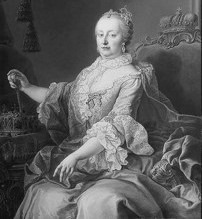
During the reign of Maria Theresa, the leather industry of St. Vith also commenced. Hubert Buschmann started in March 1752 the tannery tradition of St. Vith, that during its economic boom contained more than 600 pits where almost 10.000 hides were processed.
The leather of St. Vith had a very good reputation and was brought to the fairs of Leipzig and Frankfurt using horse and carriage.
In the period of Maria Theresa, we can also find the order of the ‘Theresian Registry’, a list of inhabitants and buildings according to residence and judicial areas that was made for tax purposes. In the registry of St. Vith you can read that ‘the city is not completely rebuild and partly in very bad condition’. A tax in the current meaning of the word did not yet exist because the tax of the citizens of the city was then half of the tax of the foreigners who did not possess civil rights.
Equal right for all inhabitants and definite abolishment of servitude, forced labour and feudalism (Ancien Régime) only took place with the French Revolution. During the course of the Austrian-French war, after the battle of Fleurus (June 1794), French troops occupied what is currently Belgium and also the area around St. Vith. This meant the end of the rule of St. Vith as well as the Duchy of Luxembourg. The last feudal lord, Wilhelm of Nassau, fled to England with his family in 1795. Immediately St. Vith became the seat of a ‘Mairie’ (mayor) and built with the surrounding mayors the canton of St. Vith which was then part of the jurisdiction Malmedy in the Department of the Ourthe.
After the defeat of Napoleon at Waterloo, our territory was added to the Prussian Rhein Province (governance Aachen) at the Viennese congress (1815). St. Vith, a craft city until 1820, belonged then to the territory of Malmedy until 1920.
In this period the city saw some improvements of the quality of life (agriculture and forestry, water supply, schools, hospital, postal services, railway services). The connection with the railway (from 1887) meant an important development for the city. In its most thriving period, 30 passenger- and 80 freight trains were received on a daily basis. Around 1200 people were employed here; the importance as an industrial city grew.
World Wars and the "petite farce belge"
After the first World War of which 57 citizens of St. Vith did not return, the Prussian district cities Eupen and Malmedy were assigned to Belgium under the Treaty of Versailles.
By means of a ‘public inquiry’ (1920) that was named ‘petite farce belge’, it was ‘concluded’ that the majority of the people wanted to be part of Belgium. Of the over 33.000 eligible voters, only 271 had registered to vote and by doing this had chosen to remain in Germany. These people thus experienced many repressions and fault-findings from the Belgian government.
As a result of this ‘public inquiry’ a lot of German train personnel was transferred from St. Vith to Möderath whereby the government did not take in account the year-long friendships and family relationships.
After a five-year long transition period (Government Baltia), the area of Eupen, Malmedy and St. Vith was added to the Belgian federal state in 1925. The change of fatherland was for many, as expected, a heavy burden although favourable economic circumstances offered a possibility to come to terms with this new situation. A growing population and strong building activities during the interim years of war, testify of an economic prosperity that slowed down after the worldwide economic crisis of 1929.
After the entry of the German troops on 10 May 1940, the area of Eupen-Malmedy-St. Vith was added to the National Socialist Deutsche Reich by the Führer Adolf Hitler and was sucked into the disturbances of the Second World War. The other National Socialist organisations of the Reich also recruited members here. Many conscripts had to fulfil their military service with the German forces (Wehrmacht) against their will. This turned them into enemies of the Belgian state at the end of the war.
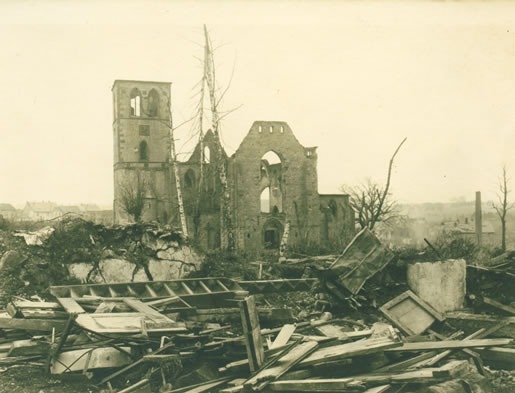
St. Vith felt the first consequences of the war on 9 August 1944, when the church and train station were destroyed by bombs: six people lost their lives. On September the 3th the order came through to evacuate which most people obeyed. They left the city with a heavy heart in the direction of Hannoversch-Münden and Dransfeld. The Americans occupied the city in the middle of September and the Belgian government took over the control. On 16 December the Ardennes Offensive started with, amongst other, the bombardment of St. Vith. However, the capture of the city failed and, in this way, foiled the whole Offensive which then developed into a war of positions. Before Christmas, German forces, once again, moved into St. Vith.
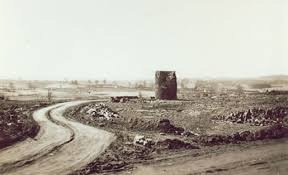
On both Christmas Days the catastrophe broke out over St. Vith: allied bombers turned the city in debris; 153 citizens of St. Vith and more than 1000 soldiers died on these two days alone. Almost 600 buildings were destroyed or heavily damaged (more than 90%).
Notwithstanding this tragic happening, the inhabitants of St. Vith built up their city again on the same spot. The rubble of the bombarded city became the ‘Millionenberg’ and life returned to the emergency houses of this ‘new city’.
The reconstruction lasted until the 60s: the hospital (reopening in 1953), the church (initiated in 1959), the schools and of course the many private buildings were built again and, in this way, healed the wounds that were made by the war.
St. Vith developed once more into a business centre of near and far. Stock-, farm- and year markets, business- and agriculture exhibitions as well as newly opened stores and companies were witnesses of an economic prosperity. The growing traffic had a negative effect on the train station which, because of the by the war destroyed infrastructure and decreasing demand, was not competitive anymore and finally was demolished. In the train station we now find the Heimatmuseum (Regional Museum).